
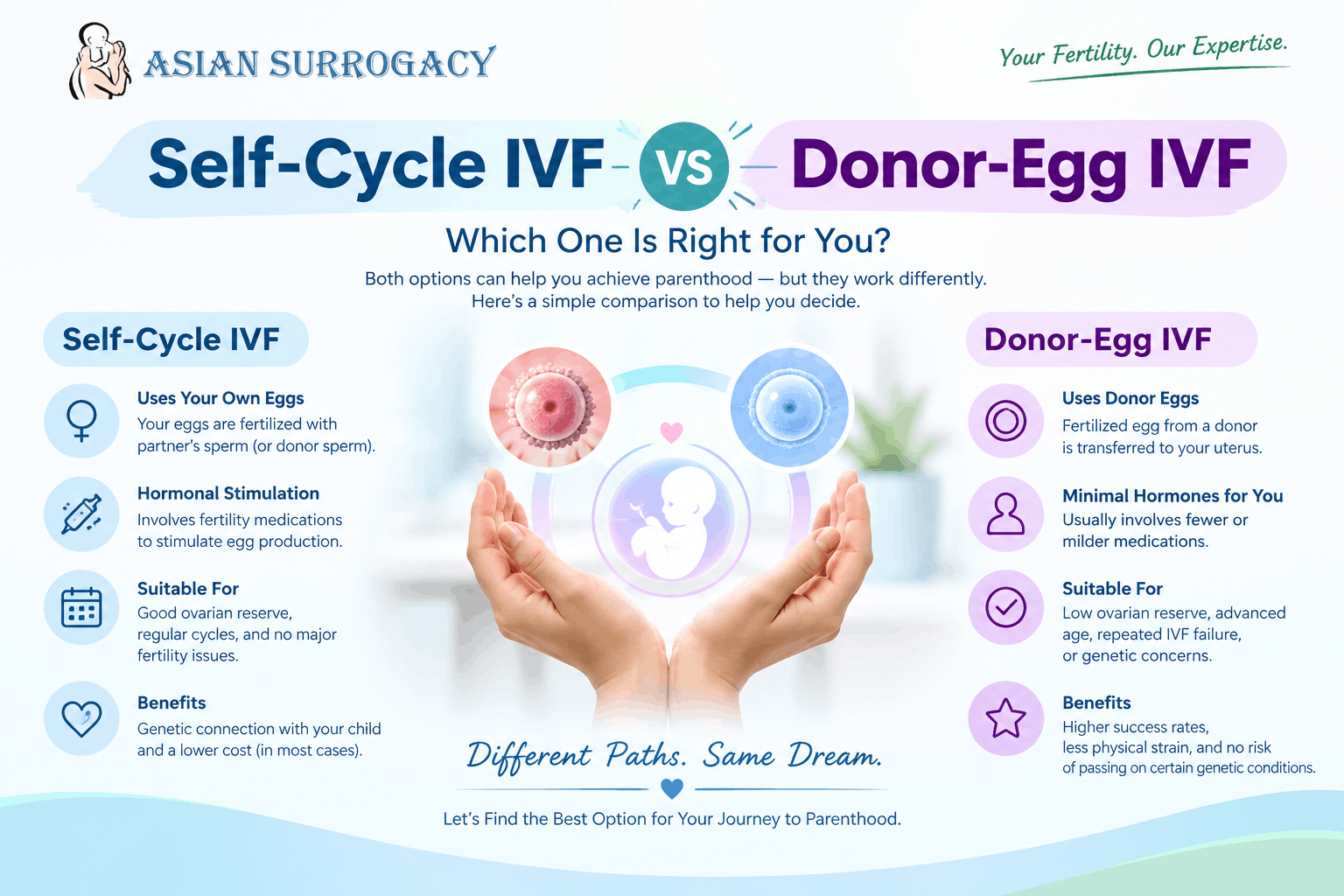
Self-Cycle vs. Donor-Egg IVF: The Ultimate Financial Planning Guide for Intended Parents
Choosing between using your own genetic material or opting for a donor is one of the most emotional and financial crossroads in the fertility journey. At asiansurrogacy.com, we help families navigate these complexities by breaking down the "real cost" of parenthood.
While a self-cycle IVF attempt might look cheaper on paper, the long-term cost of surrogacy is often dictated by one factor: the number of attempts required to reach a live birth.
1. Understanding Self-Cycle IVF Costs (Autologous)
For many intended parents, starting with a self-cycle is the first choice. This process involves using the intended mother’s eggs.
- The Price Tag : A single cycle typically includes ovarian stimulation medications (which can cost $3,000–$6,000 alone), ultrasound monitoring, egg retrieval, and lab fertilization.
- The Success Rate Variable : This is where financial planning gets tricky. IVF success rates decline with maternal age. If you are over 35, you may require 3 or 4 cycles to achieve one viable embryo, effectively tripling your initial budget.
- Internal Link Oppurtunity : Check our guide on preparing for egg retrieval to maximize your chances during a self-cycle.
2. The Financial Breakdown of Donor-Egg IVF
Choosing a donor egg is often a strategic financial decision to minimize the risk of repeated failed cycles.
- Upfront Costs : You will encounter egg donor compensation fees, agency matching fees, and legal contracts. These typically range from $15,000 to $30,000.
- Higher Certainty : Because donors are young and medically screened, the egg donor requirements at asiansurrogacy.com ensure high mitochondrial health. This leads to significantly higher success rates per transfer, often saving parents tens of thousands of dollars in "failed cycle" costs.
- Medication Savings : In a donor cycle, the intended mother (or surrogate) does not need expensive stimulation drugs—only hormonal prep for the uterus, which is substantially cheaper.
3. Comparative Cost Table: At a Glance (INR)
| Expense Item | Self-Cycle (Per Attempt) | Donor-Egg Cycle (Per Attempt) |
|---|---|---|
| Fertility Medications | ₹2,50,000 - ₹5,80,000 | ₹42,000 - ₹1,25,000 |
| Agency/Donor Fees | ₹0 | ₹12,60,000 - ₹21,00,000 |
| Lab & Retrieval | ₹8,40,000 - ₹12,60,000 | ₹8,40,000 - ₹12,60,000 |
| Probability of Success | Moderate/Low (Age-dependent) | High (Consistent) |
| Total Est. Cost | ₹10,90,000 - ₹18,40,000 | ₹21,42,000 - ₹34,85,000 |
4. The "Hidden" Costs of Surrogacy
Whether you choose self-cycle or donor eggs, you must factor in the surrogacy cost breakdown. This includes:
- Surrogate Compensation : The base pay for your gestational carrier.
- Legal Fees : Ensuring your name is on the birth certificate from day one.
- Insurance : Complications insurance for the surrogate.
5. Final Verdict: Which is Right for Your Budget?
If you are under 35 with a high ovarian reserve, a self-cycle at asiansurrogacy.com is a viable financial starting point. However, for those seeking the fastest, most financially predictable path to a baby, donor-egg IVF offers a higher "return on investment" by reducing the emotional and physical toll of multiple failed IVF attempts.
Ready to build your budget?
Contact our financial coordinators today for a personalized consultation.