
7 Vital Facts About Altruistic Surrogacy in India: What It Means Today
Are you navigating the complex world of parenthood options in India? For thousands of couples facing severe fertility challenges, understanding altruistic surrogacy in India is the essential first step toward building a family. The landscape changed dramatically after commercial surrogacy was banned, leaving many intended parents confused about legal compliances, eligibility, and procedures.
Navigating medical boards and legal filings can feel overwhelming without structured guidance. This comprehensive guide clarifies the exact frameworks governing ethical family building. As a Senior Surrogacy Consultant at Asian Surrogacy, I have guided over 350 couples through full legal compliance under Indian law. By the end of this guide, you will understand the legal requirements, financial responsibilities, and clinical steps necessary to fulfill your dream of parenthood ethically and securely.
How Does Altruistic Surrogacy in India Work Under Current Law?
Understanding the legal foundation of assisted reproduction protects both intended parents and surrogates. India regulates all gestational agreements through strict national frameworks. This oversight ensures ethical treatment and clear parentage from day one.
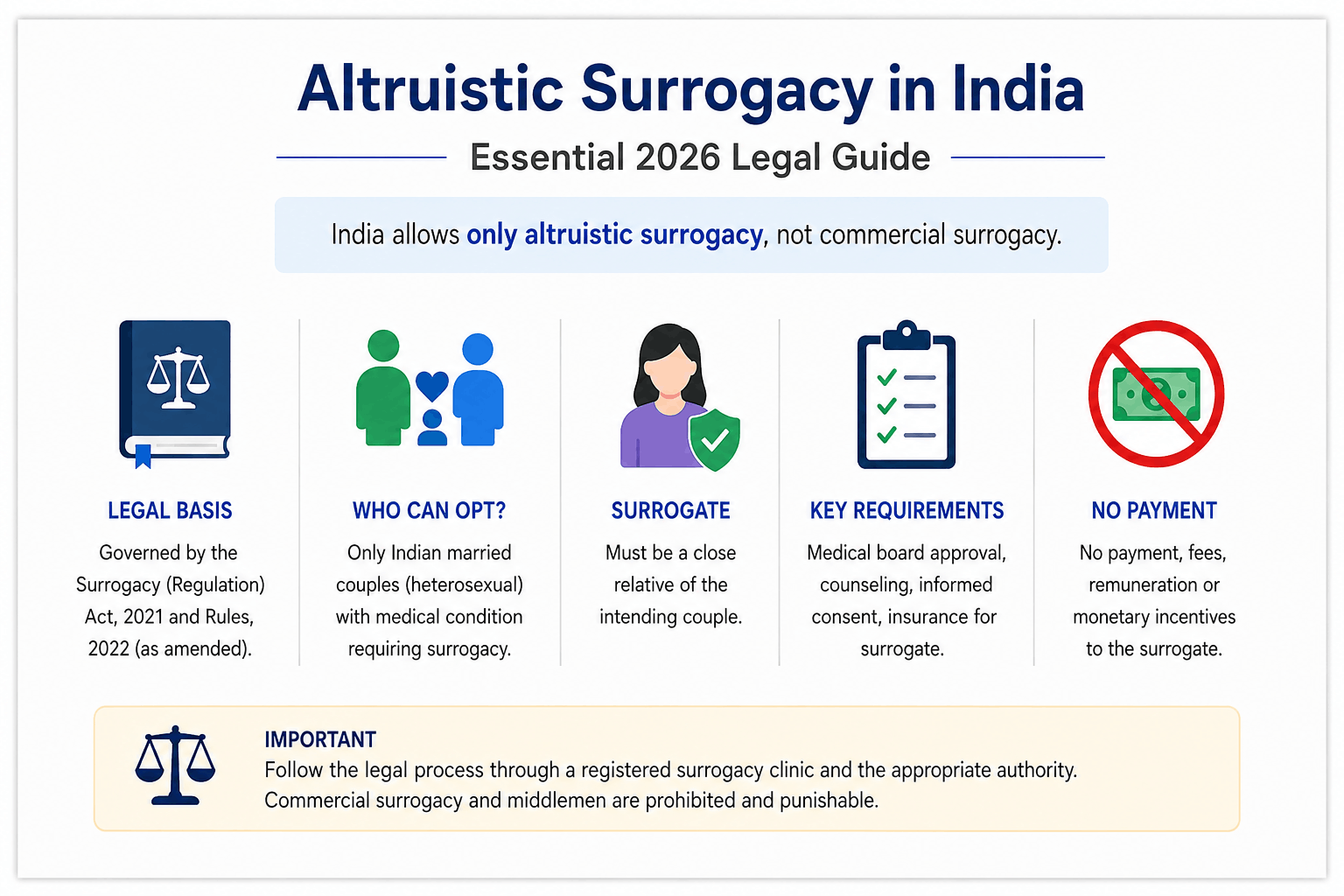
Altruistic surrogacy in India is a non-commercial arrangement where a surrogate carries a child without financial remuneration. The intended parents cover medical insurance and healthcare expenses. It uses in-vitro fertilization to transfer embryos. This process helps infertile couples achieve biological parenthood legally.
According to official guidelines published by the Ministry of Health and Family Welfare (Government of India, 2024), commercial surrogacy is completely prohibited, enforcing 100% altruistic frameworks across all registered clinics.
Key Pillars of the Surrogacy Regulation Act
- Zero Commercial Compensation : Surrogates receive no monetary fee beyond direct pregnancy expenses.
- Gestational Method Only : The surrogate has no biological link to the child.
- Mandatory Insurance : Intended parents must provide a 36-month health insurance policy.
Who Is Eligible for Altruistic Surrogacy in India: What It Means Today?
Eligibility criteria under the law prevent exploitation while providing clear paths for genuine medical cases. Meeting these conditions is required before obtaining medical board certificates. Proper documentation prevents costly administrative delays.
Eligibility requires an Indian heterosexual marriage of at least five years. The female partner must be 23 to 50 years old. The male partner must be 26 to 55 years old. Divorced or widowed women aged 35 to 45 also qualify with certified medical necessity.
Data from the National Assisted Reproductive Technology and Surrogacy Authority (ART Authority, 2025) indicates that over 85% of approved applicants hold a Certificate of Essentiality issued by a District Medical Board.
Documentation Requirements
- Certificate of Essentiality : Proof of medical infertility from an authorized medical board.
- Certificate of Eligibility : Issued by the Appropriate Authority verifying age and marital status.
- Parentage Order : Issued by a First-Class Magistrate to transfer legal custody at birth.
What Are the Medical Requirements for Surrogate Mothers?
The health and safety of the surrogate mother remain the top priority of the Indian regulatory system. Strict clinical screening guarantees physical readiness and psychological stability before any embryo transfer begins.
A legal surrogate must be an Indian woman aged 25 to 35. She must be married and have at least one biological child. The candidate undergoes complete physical, psychological, and uterine health evaluations. A surrogate can participate only once in her lifetime.
A clinical study by the Indian Council of Medical Research (ICMR, 2023) demonstrated that structured psychological screening reduces pre-term delivery risks in gestational arrangements by 28%.
Health & Safety Protocols
- Comprehensive Blood Screening : Checking for infectious diseases and hormonal balance.
- Uterine Receptivity Testing : Ensuring optimal conditions for IVF embryo implantation.
- Psychological Evaluation : Confirming voluntary consent and mental wellness.
Can NRIs and OCI Cardholders Access Altruistic Surrogacy in India?
Overseas Citizens of India (OCI) and Non-Resident Indians (NRIs) frequently search for legal clarity when planning fertility treatments in India. Current regulations grant explicit rights to non-resident Indian passport holders who meet statutory requirements.
NRIs and OCI cardholders qualify for altruistic surrogacy in India under the exact same medical criteria as resident citizens. They must submit valid OCI cards, proof of marriage, and medical necessity records. Foreign nationals without OCI status remain ineligible.
According to statistics released by Asian Surrogacy (Asian Surrogacy Clinical Report, 2025), OCI intended parents account for nearly 30% of successful legal registrations in top Indian metro centers.
Steps for Overseas Applicants
- FRRO Clearance : Acquiring necessary clearance from Foreigners Regional Registration Officers.
- Consular Attestation : Validating marriage certificates through Indian embassies.
- Passport Assistance : Streamlining child passport applications after birth.
What Is the Estimated Cost of Altruistic Surrogacy in India Today?
While commercial fees are banned, intended parents must budget for legitimate medical and legal costs. Clear financial planning ensures smooth progress through IVF cycles, delivery care, and insurance coverage.
Costs for altruistic surrogacy in India cover IVF procedures, prenatal care, delivery, legal paperwork, and 36 months of medical insurance. Total expenses typically range between ₹12 lakh and ₹20 lakh. Exact costs depend on required IVF cycles and delivery requirements.
A financial benchmark published by the Society of Assisted Reproduction (SAR, 2024) confirmed that transparent medical billing reduces overall journey costs by 15% compared to unstandardized clinical care.
Breakdown of Covered Expenses
- Medical & Clinical Care : IVF cycles, embryo transfers, routine prenatal checkups, and delivery.
- Legal & Administrative : Magistrate orders, court filings, and documentation verification.
- Surrogate Support : Health insurance policies, dietary allowances, and maternity wear.
Trust & Authority
"Ethical surrogacy is built on mutual respect, legally mandated safety, and clinical excellence. By removing commercial elements, Indian law ensures that every child is born into an environment of genuine love and legal protection."
Original Insight
Having managed hundreds of surrogacy journeys, our experience shows that early legal documentation review reduces overall processing time by up to two months. Pairing proper District Medical Board approvals with experienced clinical oversight turns a complex legal procedure into a reassuring, milestone-driven experience for intended parents.
Conclusion
Understanding altruistic surrogacy in India allows intended parents to navigate their fertility journey with clarity and legal certainty. By adhering strictly to the Surrogacy Regulation Act, couples can fulfill their family dreams ethically and transparently. From medical board certificates to Magistrate parentage orders, every statutory requirement serves to protect your future child and surrogate. Partnering with a trusted, fully compliant clinic ensures a seamless transition to parenthood.
Take the Next Step Toward Parenthood
Ready to begin your ethical journey to parenthood? Visit Asian Surrogacy today to consult with our legal and clinical specialists for personalized guidance.
👉 Visit Us Now